
Reconfigurable Microfluidic Device for Drug Synthesis
August, 2021 - August, 2022
This research aims to develop a reconfigurable microfluidic chip that could be used in drug synthesis optimization. The proposed device is capable of redefining its fluidic channel using a large array of microvalves, thus, various tasks could be performed using a single device.
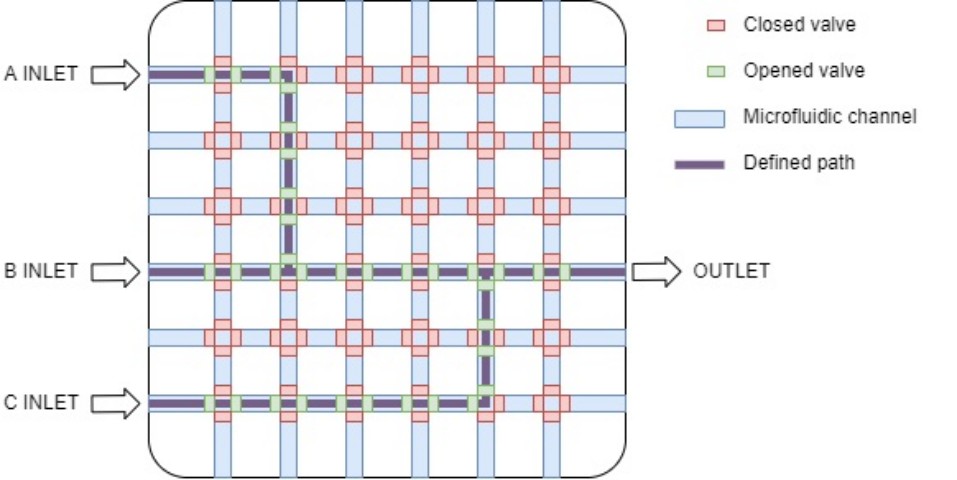
The reconfigurable microfluidic device concept example consists of several vertical and horizontal microfluidic paths. At each junction are located four microfluidic valves. The valves shown in green are opened to form a path as illustrated by dark grey lines. The current part allowed a mixture of chemicals A and B then chemical C is added later. The mixture exited the device on the right side.
To achieve such a goal, a highly scalable microvalve with a fast response time is needed to be designed. A Peltier actuated microvalve has been proposed, using a bidirectional heat pump, the valve is expected to perform a fast closing and opening action. The valve is fabricated using 3D printed and CNC metal parts, avoiding microfabrication complications and minimizing the cost and production time. An electronic circuit capable of controlling a large array of valves is also proposed.
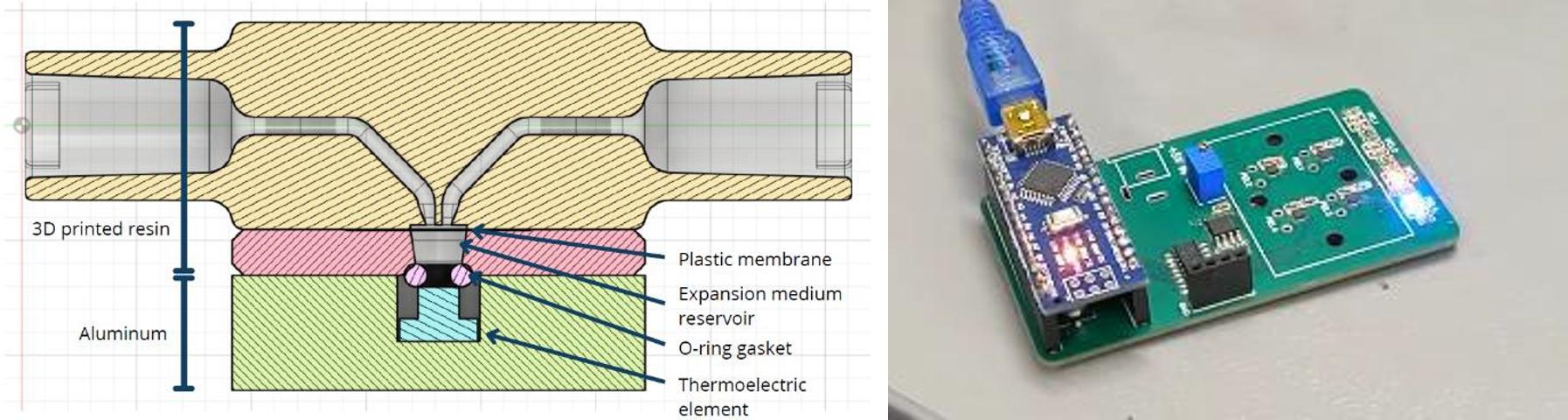
Detailed design of Peltier Driven Thermal Actuated Microfluidic Valve Prototype (Left). Fully assembled PCB (Right). The PCB is connected to the computer via a USB cable. In this picture, the LED array states that the PCB is signaled to close valve number 3 (red light), and open valve number 4 (blue light). The PCB is modular and can be cascade with others to control large network of valves.
The cost of the fabricated valve is less than $35 per valve, it can be closed in 1.11 seconds and opened in 1.85 seconds. Further development could reduce the response time of the valve and the integration of the valve to form an array is highly feasible.
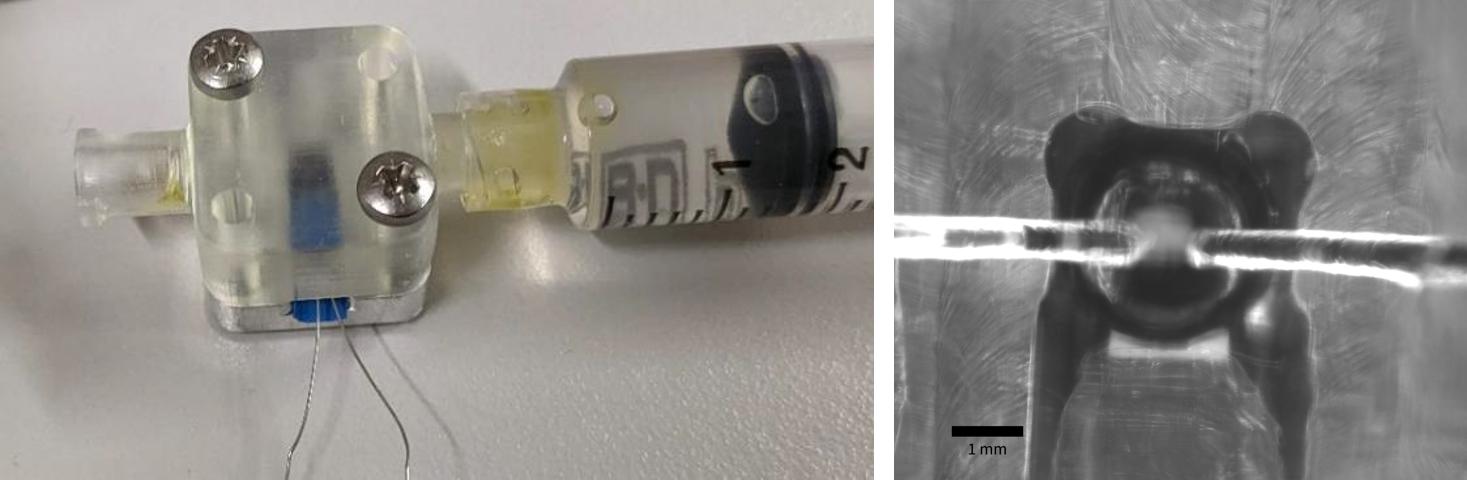 The assembly of the Peltier-driven thermal actuated valve (Left). The syringe is connected to the right side of the valve as an inlet for the liquid. Top-view image of the valve from a light microscope (Right).
For more details about this work, please see my Master’s Thesis here